Moorland-Spingarn Research Center's Christina Vortia on Dorothy Porter and Black Children's Books
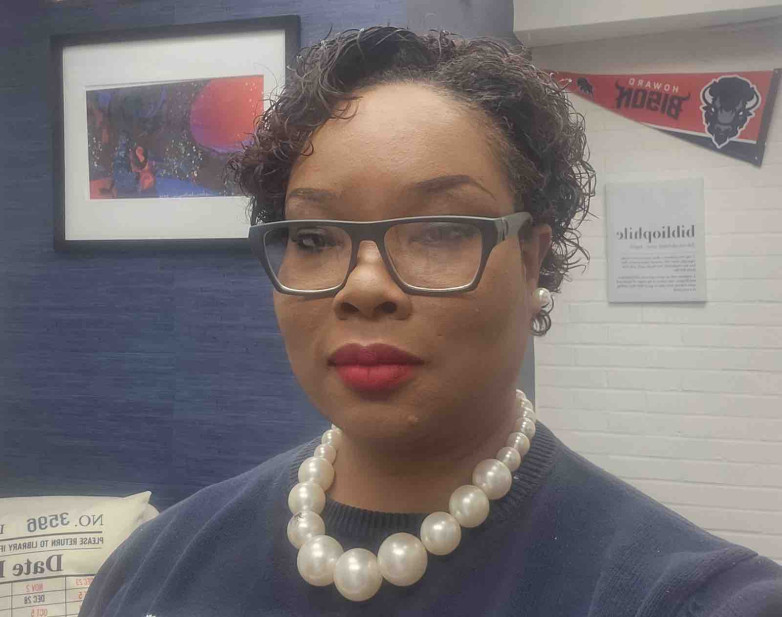
Christina Vortia



Our Bright Young Librarians series continues today with Christina Vortia, Chief Librarian at the Moorland-Spingarn Research Center at Howard University in Washington DC.
What is your role at your institution?
My official title is Chief Librarian of the Moorland-Spingarn Research Center's Library Division. In this role, I am the steward of rare books, journals, serials, and Dorothy Porter's historic vertical files. I am also the Subject Liaison for African Studies and African American Studies for Howard University Libraries. In both roles I provide library instruction, serve as tour guide, manage staff and students, facilitate professional development, and prioritize collection preservation and management.
Though I do all of these things and more, I see myself more as a translator of ancestral intelligence. I see the collections as a cosmological love letter crossing through space and times where the ancestors wanted us to know, in every time and every place, that we are loved. One of the most beautiful aspects of this role is connecting these books, which I see as ancestors, to their descendants. It is deeply moving and spiritual work. Every day I aim to do justice to Dorothy Porter's legacy.
How did you get started in special collections?
My path here was not straight. My work in libraries began when I was 11 years old as a volunteer at the Mt. Olive Public Library cleaning children's books in anticipation of the Summer Reading Program. I got my first paid job in libraries at 14 years old as a library page at the Dover Free Public Library. I worked there for a few years while in high school. I got into special collections after graduating from college. My first job after graduation was at the US Merchant Marine Academy library in Kings Point. An alum donated materials to the library, and I was charged to sort through the rare books, maps, and artifacts. This was my first encounter with the behind-the scenes intimacy of special collections.
Where did you earn your degrees?
I earned my MS in Library and Information Science from Pratt Institute in NYC in 2015.
Favorite rare book / ephemera that you've handled?
There have been many, but the Moorland-Spingarn Research Center's inscribed copy of The interesting narrative of the life of Olaudah Equiano might be one of my favorites. Inside is a letter written by Equiano in 1792. It described a wedding in the most beautiful and ornate script. When I think of the beauty and pride of the note, it's a reminder that in all times we can find joy.
What do you personally collect?
I am a collector of Black children's books. My favorite is a pop-up book illustrated by George Ford, "The Hunter Who Was King and Other African Tales adapted by Bernette Ford. I also collect Black toys and games.
What do you like to do outside of work?
I am a mother of five children, so I enjoy making memories with them. When I'm alone, and I enjoy my "me-time" I'm reading and enjoying a sumptuous snack.
What excites you about special collections librarianship?
I'm most excited by the opportunity for librarians, archivists, and curators to tell new stories in new ways using special collections. While the public's imagination seems to be bent towards artificial intelligence, we hold on to something more real, tangible, and enduring - ancestral intelligence. It's our moral obligation to help current and future generations to understand that the internet is not the keeper of all knowledge. Special collections libraries and archives have a lot of secrets, and the opportunity for discovery is great.
Thoughts on the future of special collections librarianship?
I love that there is a new generation of archivists and librarians that are expanding traditional thoughts of what these roles and collections can be. Solange's digital archive of rare works by Black and Brown creators is a testament to the shift. I follow the Hoochie Historian and love a good Hip Hop archive. I encourage students to that come to visit the MSRC Reading Room that they occupy a significant and pivotal time in global history - they are the "Zoomers", transitioning to online school during the pandemic.
That experience is begging and screaming for documentation and preservation. While we preserve the past, we must remember to document and preserve the present. We also need to remember that while digitization is cool - it's accessible, and everyone loves that - what happens to digital archives in 100 years? What happens in a subscription-based society when we have to pay in perpetuity to access to everything? We cannot abandon preservation of tangible things for the cool now.
Any unusual or interesting collection at your library you'd like to draw our attention to?
There are too many to name - the vertical file system in and of itself is fascinating. The Moorland-Spingarn has the National Black Roller Skating Archive, Jack and Jill of America, the Congressional Black Caucus, and Black Greek materials. We even have ephemera that belonged to Frederick Douglass and paintings by Paul Robeson....I could go on, but we don't have space in this article!
Any upcoming exhibitions at your library?
I'm in the process of planning, Full: A Pan-African Cookbook Festival celebrating cookbooks as Black archival memory through the exhibition of rare Black diasporic cookbooks. The celebration plans to bring recipes to life through a food festival where we bring the culinary magnificence of the diaspora onto the lively Howard University campus. A wide range of activities are planned and I'm really excited for it.