William Blake’s Handprinted Publications Centrepiece of New Exhibition
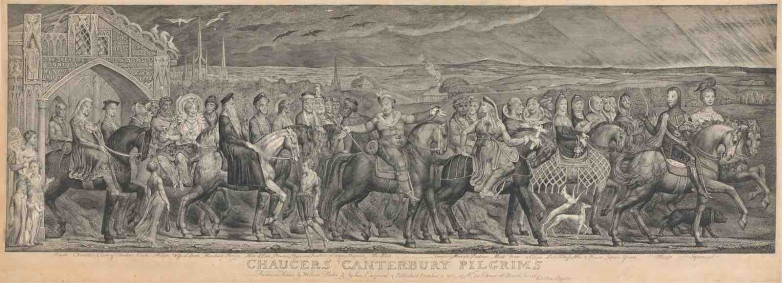
William Blake, Chaucer's Canterbury Pilgrims, 1810 to 1820, etching and engraving on medium, slightly textured, cream wove paper



A major exhibition of works by William Blake is running at the Yale Center for British Art exploring the imaginative visual art and poetry held by the museum.
William Blake: Burning Bright focuses on the handprinted publications that merge the artist’s poetry, pictures, and prophecies. The YCBA’s holdings of Blake comprise more than 900 works, including paintings, drawings, prints, and books, many of which were executed in Blake’s signature invention, illuminated printing, a revolutionary process of relief etching that made it possible to fuse text and pictures on a single copper plate.
“Blake’s extraordinary inventiveness and unconventional worldview have made him one of the most enduring figures in British art and literature,” said Martina Droth, Paul Mellon Director. “His work is at once tumultuous, forboding, and joyous, and in these complexities it still connects with us now."
Largely assembled by the museum's founder Paul Mellon, the collection encompasses Blake’s most celebrated books, including Songs of Innocence and of Experience (1789–94) and America: A Prophecy (1793), as well as the only complete hand-colored version of Jerusalem (1804–20).
Forming the center of the exhibition at New Haven, Connecticut, these books showcase Blake’s creative aspirations as poet, visionary, printmaker, and watercolorist.
Spanning Blake’s five-decade career from the 1780s until his death in 1827, Burning Bright examines the wide range of media in which he worked, including drawing, printmaking, and painting. Featured works include I Want! I Want! (1793), an early illustration for a children’s book that reveals Blake’s imaginative inclinations, and the intimate Virgin and Child (made between 1818 and 1826), which demonstrates Blake’s unique interpretation of historic tempera painting techniques.
The large-scale watercolors Blake made to accompany the poetry of Thomas Gray highlight his radical approach to book illustration, while his monumental three-foot-long engraving Chaucer’s Canterbury Pilgrims (1810–20) and extended series illustrating the biblical book of Job (1826) exemplify his practice of translating classic texts into arresting imagery.
A special reading room in the galleries will allow visitors to peruse exacting facsimiles of several works in the exhibition, providing an experience of individual works in book form.
William Blake: Burning Bright runs through November 30, 2025, and is accompanied by a new volume exploring the museum’s collection of works by Blake.